IKEA Secondhand - Preloved C2C Marketplace
Redesigned a new Peer-to-Peer React Marketplace for IKEA as part of their new IKEA @ Home inititiative
Year
2024-2025
Client
Ingka (IKEA)
Platform(s)
React Web App
Areas
C2C
Project overview
IKEA Secondhand is a customer-to-customer (C2C) marketplace that enables customers to buy and sell secondhand IKEA furniture. The platform launched first in Poland and is scheduled to expand across additional European markets.
The product needed to deliver a trusted, accessible, and distinctly IKEA experience, while addressing the inherent challenges of C2C commerce - such as retention, trust, and keeping transactions on-platform.
Results & Impact
Successfully launched in Poland, and since then has expanded and launched in Portugal & Spain, with the Norway marketplace launching before April 2026 and the rest of Europe in the later phases.
Thousands of live listings shortly after launch
700 confirmed sales within the first week of launch
Validated the platform’s UX, technical approach, and scalability for future European rollouts
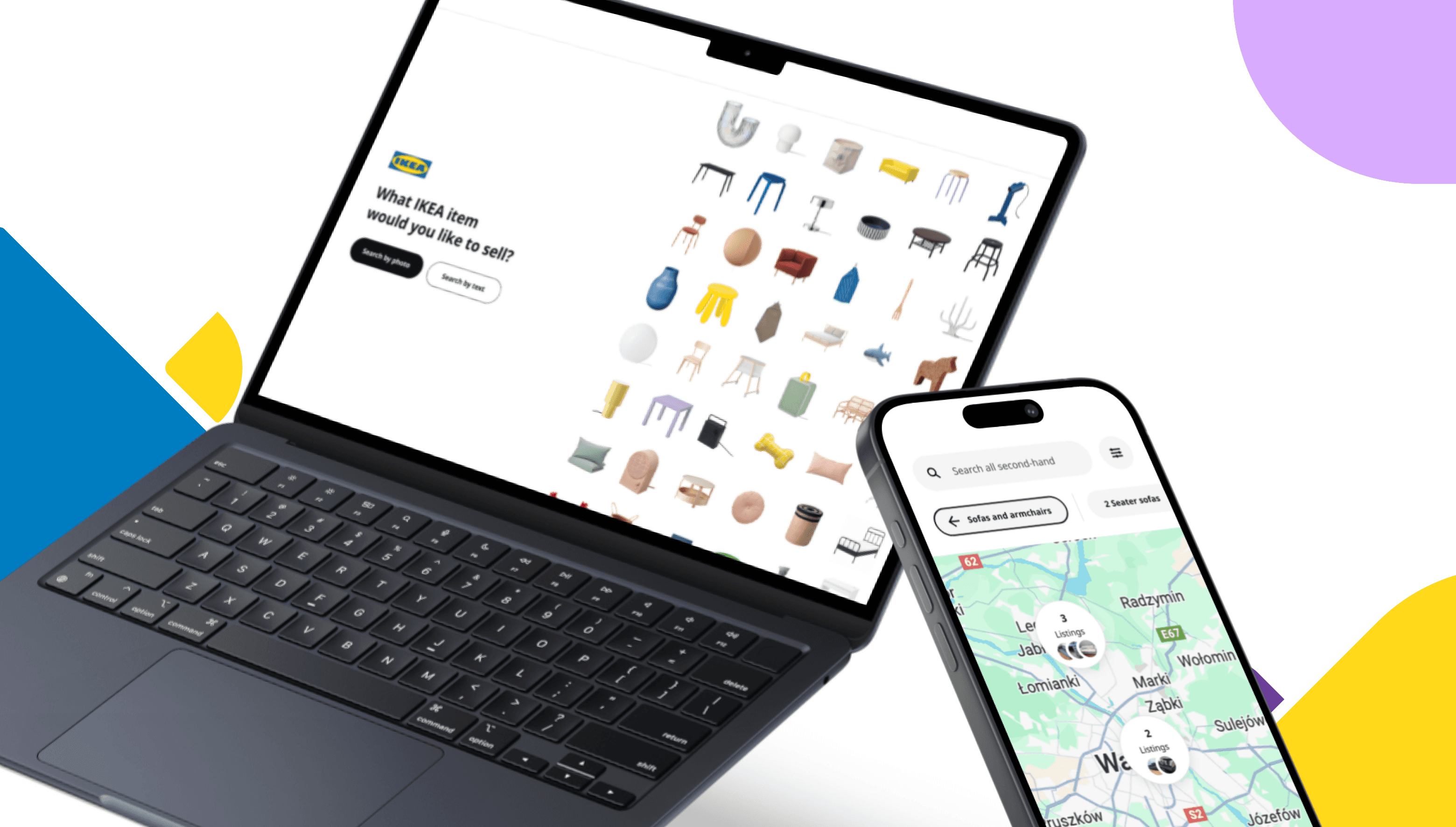
In late 2024, our team at UltraCommerce had the opportunity to be work with IKEA, the largest furniture manufacturing and direct-to-customer home and lifestyle brand in the world. We were onboarded to their IKEA @ Home directive, a business goal for IKEA to be closer to the customer in the evolving eCommerce landscape of 2025.
The project our team picked up and and worked on was the IKEA Secondhand marketplace, a preloved marketplace that allows IKEA owners to buy and sell secondhand IKEA furniture with a goal to foster a community as well as creating an IKEA ecosystem to keep customers engaged in the brand even post initial sale.
Key role & responsibilities
Led the design of core buying and selling journeys for a C2C marketplace
Translated Ingka’s research insights and customer data into product decisions and UI solutions
Delivered high-fidelity, development-ready designs using UltraCommerce’s Glyde design system
Customised Glyde via design tokens to fully align with IKEA’s brand and design system
Partnered closely with engineering and product stakeholders to unblock constraints and ship on an accelerated timeline
Embedded accessibility standards (EEA) into every stage of design and validation
Key product challenges & design decisions
Recreating IKEA's design system at scale and speed
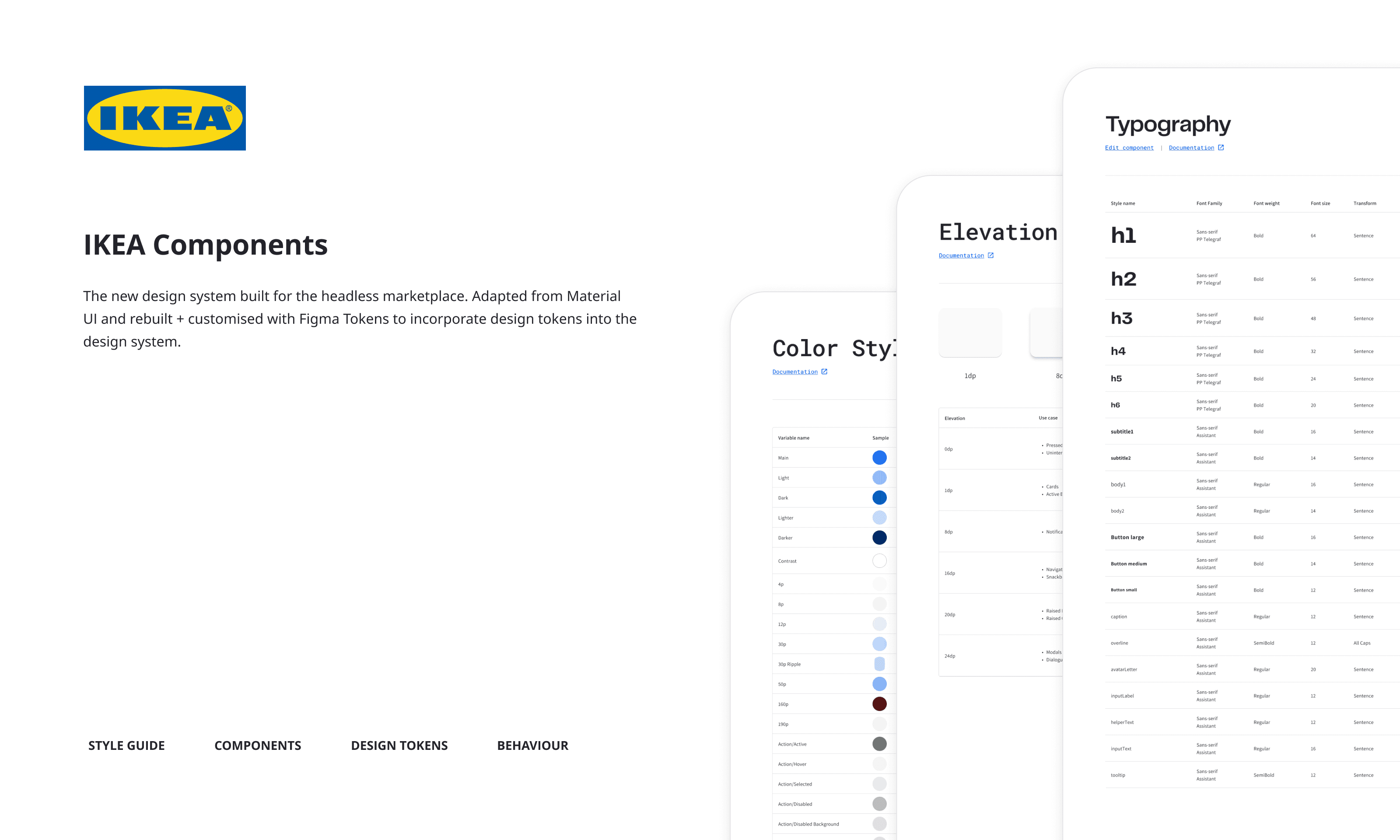
Key design challenges:
To meet an aggressive launch timeline, UltraCommerce needed to support IKEA Secondhand within our existing marketplace platform. The product had to feel indistinguishably IKEA while remaining scalable across markets.
Design Decisions and Rationale:
Rather than building a bespoke UI layer, we recreated Ingka’s design system within UltraCommerce’s Glyde system using design tokens. This allowed us to:
Preserve IKEA’s brand identity and visual language
Maintain consistency with ikea.com
Enable long-term scalability across multiple European launches
Outcome:
From a user perspective, the experience feels native to IKEA, creating a seamless transition between ikea.com and the secondhand marketplace.
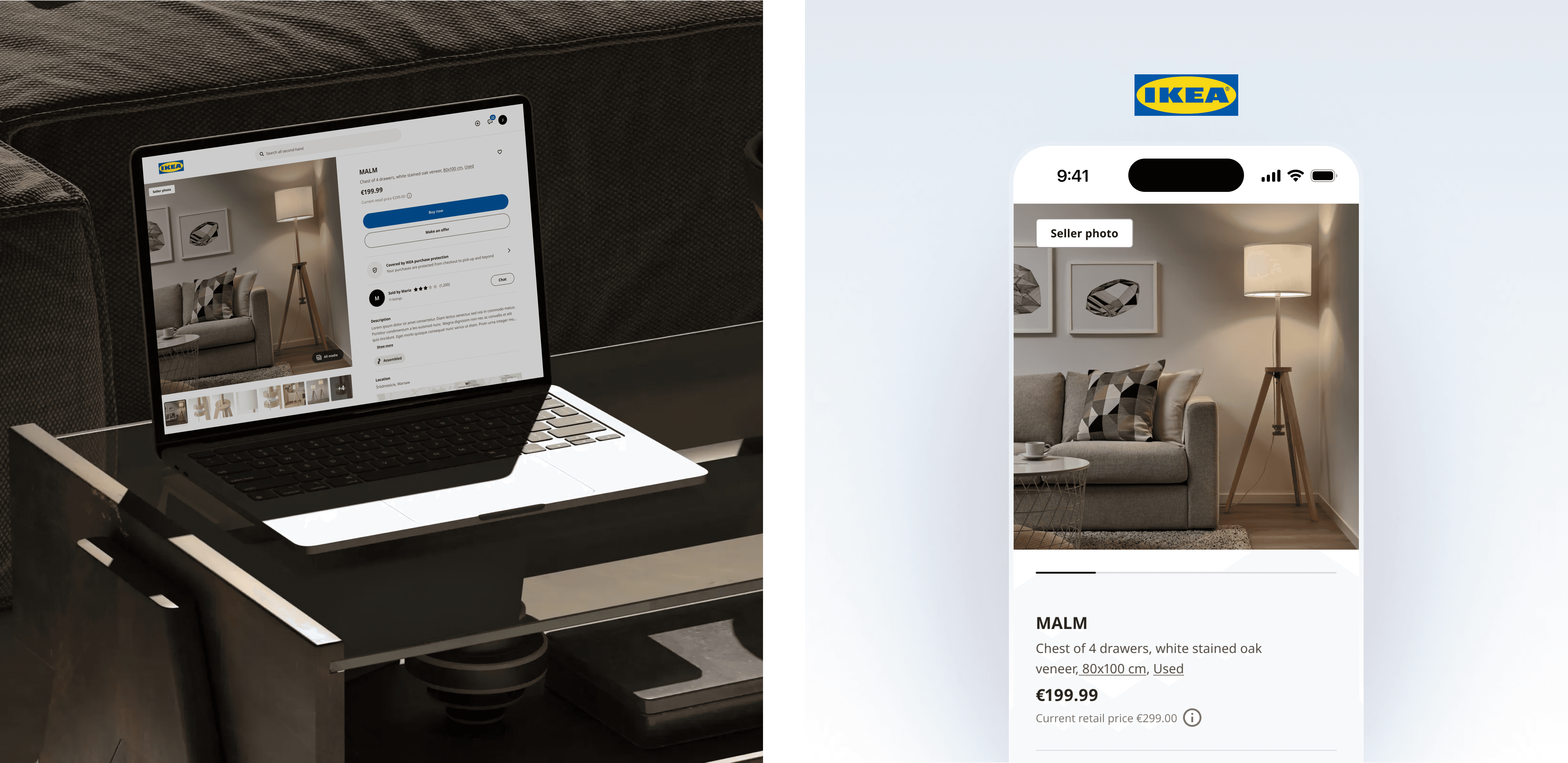
Accessibility as a Core Product Requirement
Key design challenges:
Ensuring accessibility compliance across a feature-rich C2C platform without sacrificing usability or clarity.
Design Decisions and Rationale:
Accessibility was treated as a first-class product requirement, not a post-design checklist. All flows were designed and reviewed against EEA accessibility standards, including:
Colour contrast and typography
Focus and interaction states
Clear hierarchy and readable content
This approach ensured inclusive access while maintaining IKEA’s visual standards.
Designing for pick-up (collection) for Phase 1
The marketplace was designed to support multiple discovery paths while converging into a single purchasing decision. Customers could arrive at an item through search, category browsing, or homepage recommendations. Once an item was discovered, the journey diverged based on whether negotiation was enabled, either progressing directly to purchase or moving through chat before checkout.
This initial model reflected standard ecommerce patterns, but early validation and feasibility work surfaced several structural challenges that required rethinking fundamental assumptions.
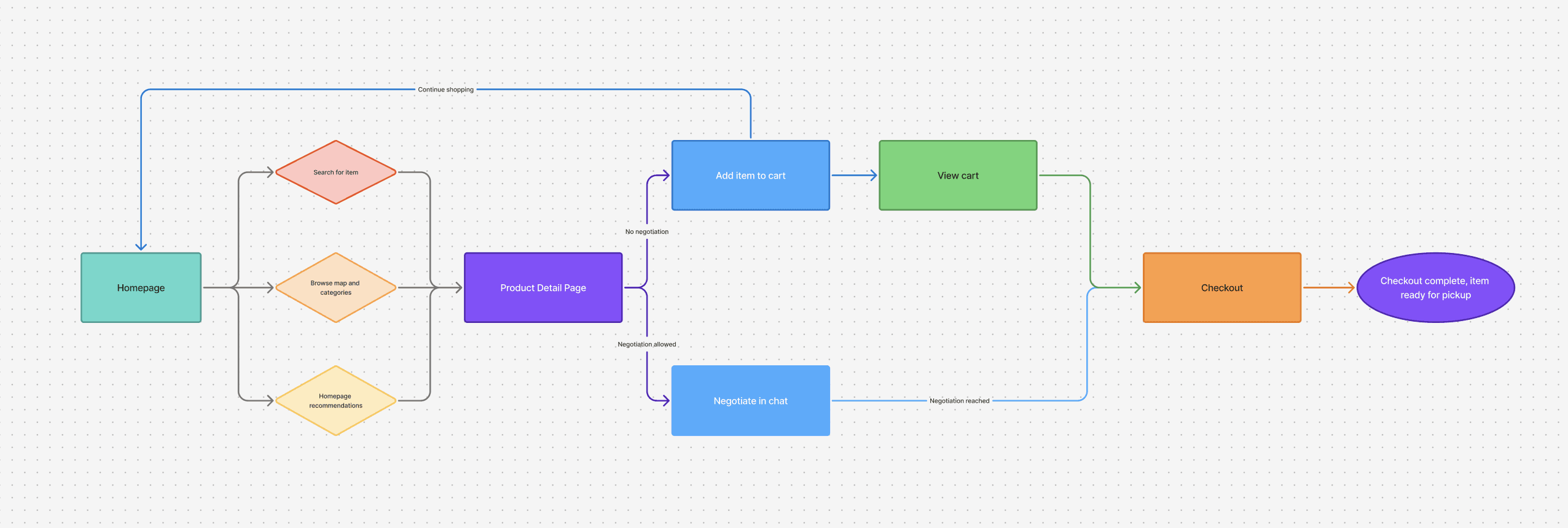
Original customer purchase journey with a multi-item cart
Key Design Challenges:
Pickup-only marketplace without shipping integration
For phase one, IKEA Secondhand launched without shipping. All transactions were pickup-only, driven by a business need to reduce complexity and risk. Because this was a web-based experience rather than a native app, we could not rely on persistent GPS access. This introduced a core discovery problem: how to ensure customers only saw relevant items within a reasonable distance.Single-stock C2C inventory
Each listing represented a single unique item. Traditional cart behavior risked creating false expectations, where customers believed an item was reserved simply because it was added to their cart.Chat as a primary transaction surface
User research and market feasibility testing showed that chat was central to how buyers and sellers closed deals. Introducing a conventional cart added friction and fragmented the purchasing experience, particularly when negotiation was involved.
Design Decisions and Rationale:
Location-first marketplace logic
To address pickup-only constraints, we centered the marketplace experience around customer-entered ZIP or postal codes. This decision needed to scale across Europe, where postal code systems vary significantly in precision. Working closely with engineering, we standardized location behavior by centering map coordinates on the midpoint of each postal code area and applying a consistent default radius.
One early iteration had the postcode selector within the search bar - signalling its importance and close integration with the shopping experience immediately as the customer arrives on the marketplace.
We explored multiple placements for postcode entry. Early iterations embedded it into the main search bar to tightly couple intent and location. Later concepts moved it into a dedicated map view. Through usability testing across responsive breakpoints, we found that placing postcode input as the first filter field struck the best balance between discoverability, visual clarity, and scalability. Participants consistently found it without prompting, while the UI remained uncluttered on smaller screens.

Final iteration utilising the filters instead as we found through user testing this balances visual clutter and discoverability of this feature the best especially in mobile.
Removing the cart in favor of single-item checkout
To solve both single-stock inventory issues and chat-related friction, I intentionally removed the cart from the experience. The marketplace was redesigned around a single-item, straight-to-checkout flow.
This eliminated the risk of customers assuming an item was reserved, reduced disappointment from last-minute availability loss, and aligned purchasing behavior whether the decision happened on the product detail page or within chat. From a system perspective, this also simplified backend logic and reduced development complexity while delivering a clearer mental model for users.
Unified purchase logic across surfaces
By standardizing checkout regardless of entry point, we created a consistent purchasing experience that supported negotiation, direct purchase, and future extensibility. This reduced cognitive load for customers and allowed the team to iterate faster without fragmenting the experience.
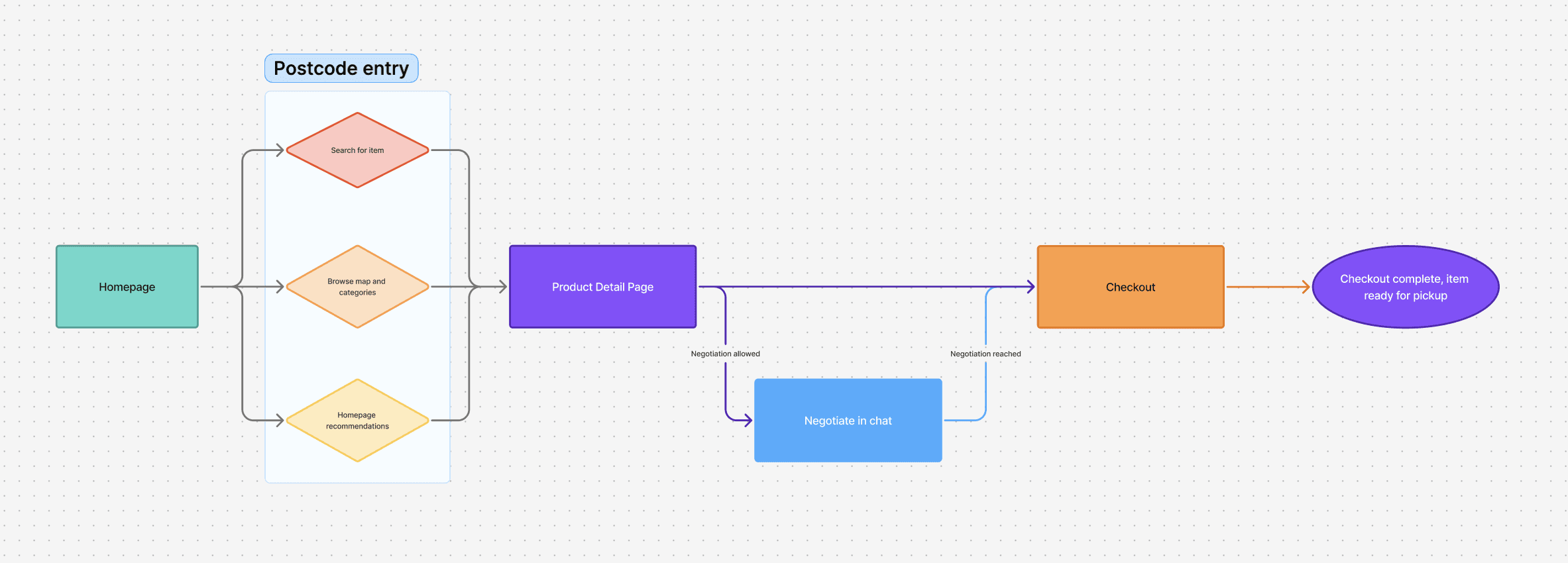
Final user flow with unified purchase logic and single item checkout
Outcome
The final purchasing journey was intentionally opinionated, optimized for real C2C behavior rather than traditional ecommerce conventions. By grounding design decisions in user research, technical feasibility, and business constraints, we delivered a scalable marketplace experience that minimized friction, reduced failure states, and reinforced trust between buyers and sellers.
This project reflects my approach as a senior designer: aligning systems-level thinking with human-centered design, collaborating deeply across disciplines, and making clear trade-offs to ship meaningful, resilient products.
Balancing user experience with techincal constraints (seller listing flow)
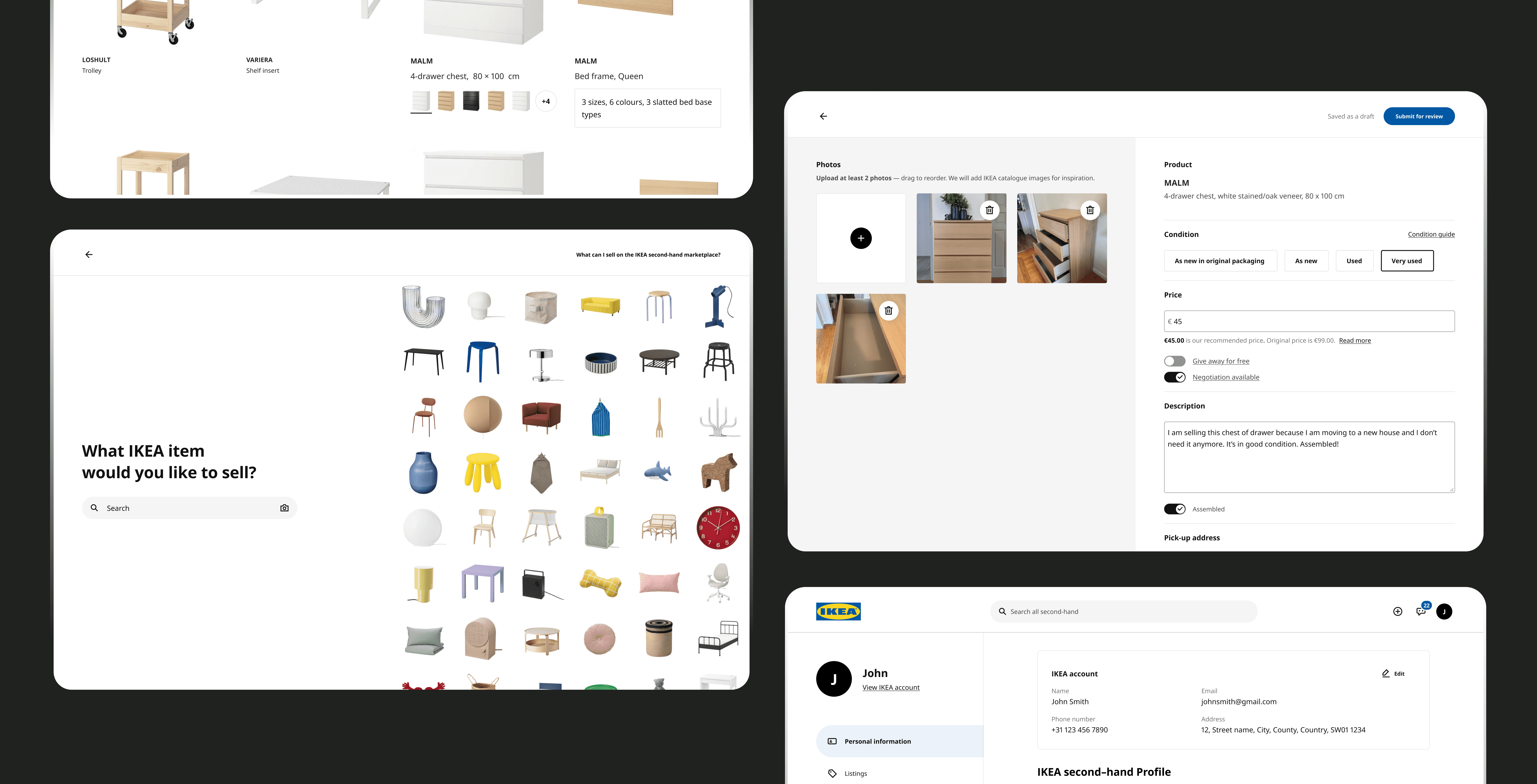
Key design challenges:
The ideal seller journey would be the following:

However, due to how Magento creates products in the backend, sellers were required to select a product colour and configuration before reaching the listing configuration screen. This meant that each product with different colours and SKU number would be it's own entry in the database, creating an issue that the same product of different colours or configuration would not be grouped together - introducing friction and potential confusion.
Design Decisions and Rationale:
I worked iteratively with engineering and tech leads to explore multiple UX solutions that balanced:
User clarity and confidence
Backend limitations
Time-to-market constraints
During the first iteration of the user flow the issue shows as the following:
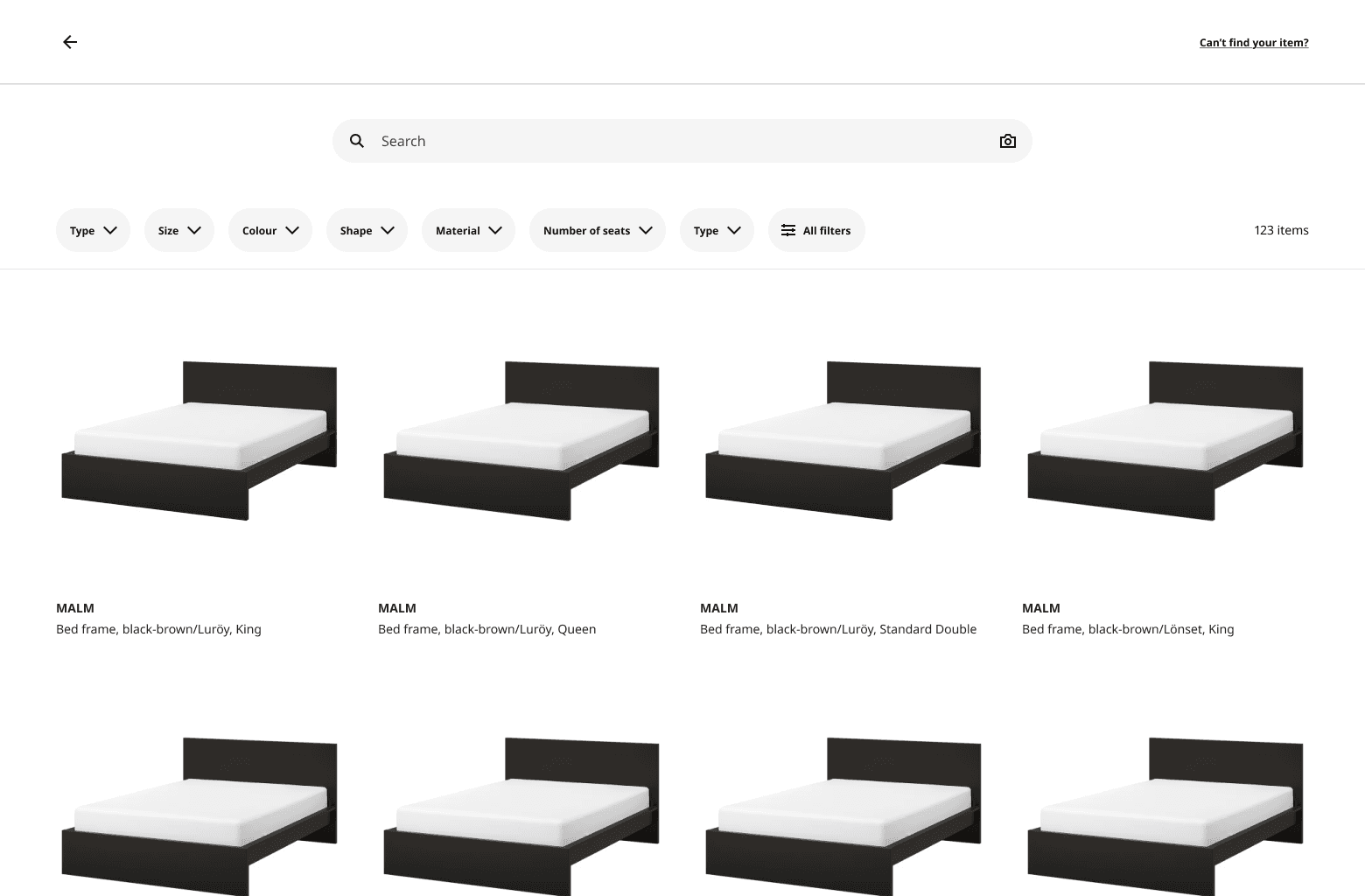
As can be observed, the products within the same product family that has different colour and configuration is shown as different tiles, which is confusing to users as this could easily case them to select the wrong product to list. Through IKEA own user testing, this carries the risk that it could confuse customers in the seller listing flow - which to a C2C marketplace is one of the most important as this create friction on the product supply of the marketplace.
Through consultation with the development team, business analysts and through various iterations with the client, the final result was the following flow.
The final flow reduced friction while remaining technically viable, allowing us to still group the product together to reduce user confusion while staying true to the IKEA design system, leading to our ability to ship without compromising the core seller experience.
Designing a chat-centred purchase flow for trust, conversion and community

Key design challenges:
In C2C marketplaces, trust-building and purchase intent often happen inside conversations rather than traditional checkout flows. At the same time, there is a clear business risk: if conversations move off-platform, the product loses both revenue and visibility into the transaction.
The challenge was to design a purchase experience that felt natural to how users already behave in C2C environments, while increasing conversion rates and keeping transactions within IKEA Secondhand.
Design Decisions and Rationale:
Rather than treating chat as a supporting feature, I designed the purchase flow around the chat experience itself, aligning with established C2C marketplace patterns that users already understand and trust.
We selected Sendbird as the chat technology, enabling structured, system-powered messages within conversations. This allowed the chat to function not just as free-form messaging, but as an interactive, transactional surface.
Key design decisions included:
Embedding structured messages for key transaction moments (e.g. intent to buy, confirmation, next steps) directly within the chat
Designing in-chat prompts and states that guide users from conversation to purchase without forcing a traditional checkout mindset
Supporting both digital and physical transaction moments (such as arranging pickup) within the same conversational flow
Maintaining consistency with industry-standard C2C chat-based purchasing patterns to reduce cognitive load and increase confidence
Outcome:
By centring the purchase journey around chat, we:
Increased the likelihood of users completing transactions on-platform
Reduced drop-off caused by moving conversations offline
Aligned IKEA Secondhand with familiar C2C marketplace behaviours, lowering the learning curve
Supported the broader goal of fostering an IKEA secondhand community built on trust, transparency, and repeat engagement
This approach positioned chat not just as a communication tool, but as a core product surface driving conversion, retention, and community growth.
Reflection
This project required senior-level product design thinking: balancing speed, scale, technical constraints, brand integrity, and user trust within a complex C2C ecosystem.
As Lead Designer, I owned the design direction and execution, collaborated deeply across disciplines, and helped deliver a marketplace experience that feels unmistakably IKEA - while supporting the realities of a scalable, revenue-generating platform.